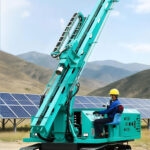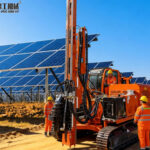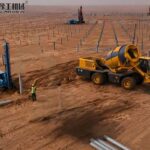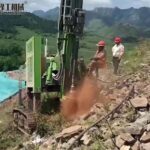
As the global demand for renewable energy continues to grow, solar developers are increasingly moving beyond flat land and building projects in mountainous regions, hilly terrain, and other challenging locations. Countries such as the Philippines, Papua New Guinea, Chile, Peru, and South Africa are seeing more solar farms constructed on slopes due to limited flat land availability.
However, installing solar foundations on uneven terrain presents unique challenges that standard pile driving equipment often struggles to overcome. Choosing the right solar pile driver for slope applications is critical for ensuring foundation accuracy, construction efficiency, and long-term structural stability.
In this article, we explore the main challenges of hillside solar farm construction and explain why a specialized photovoltaic pile driver for uneven terrain can significantly improve project performance.
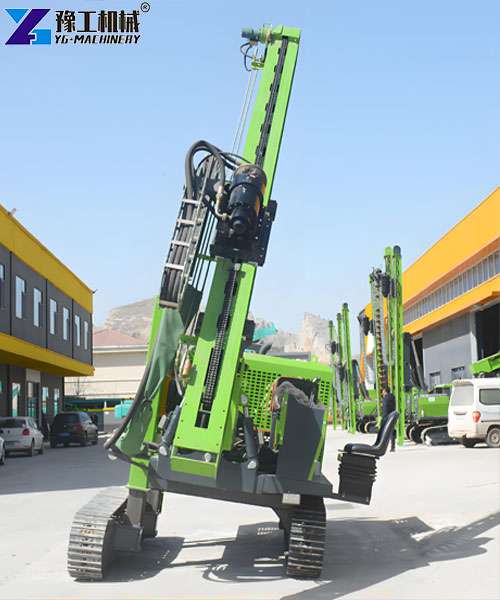
Solar Pile Driver for Slope Parameters
| Skid-Mounted Solar Pile Driver with Hydraulic Adjustable Support Legs | |||
| Overall Dimensions | 4700 × 2200 × 2800 mm | Crawler Plate Width | 300 mm |
| Engine | Yuchai 4108 | Rated Power | 88 kW |
| Max Drilling Depth | 6 m (extendable drill rod) | Max Drilling Diameter | 400 mm |
| Main Pump | Triple pump | Reducer Output Torque | 13,000N.m |
| Drill Rod Speed | 180 r/min | Hydraulic Pump | 40 / 40 / 32 |
| Applicable Rock Hardness | 6–20 F | Climbing Angle | 45° |
| Drilling boom swing angle | Left & Right 150° (±75°) | Sliding Frame Pitch Angle | 120° |
| Travel Speed | 5 km/h | Sliding Frame Swing Angle | Left & Right 40° |
| Machine Weight | 6.5 T | Crawler Height Adjustment Range | 80–120 mm |
Why Are More Solar Farms Being Built on Slopes?
Traditionally, solar farms were constructed on flat land because installation was simpler and more cost-effective. Today, however, many regions face increasing land shortages and rising land acquisition costs.
As a result, developers are turning to:
- Mountainous areas
- Hillside terrain
- Abandoned mining sites
- Undeveloped rural land
- Agricultural slopes
These locations often provide excellent solar exposure but create significant challenges during foundation installation.
For EPC contractors and solar developers, the ability to efficiently install piles on uneven ground has become a key competitive advantage.
Common Challenges of Solar Foundation Construction on Slopes
Challenge 1: Uneven Ground Elevation
Slope gradients can vary dramatically across a project site.
Even small elevation differences can lead to:
- Misaligned pile positions
- Inconsistent mounting structure heights
- Additional adjustment work during installation
Without precise pile positioning, solar mounting systems may experience uneven loads and reduced structural reliability.
Challenge 2: Machine Stability Issues
Traditional wheeled pile driving equipment often struggles on steep or uneven ground.
Common problems include:
- Wheel slippage
- Reduced traction
- Difficulty maintaining equipment balance
- Increased safety risks
These issues can significantly reduce installation efficiency.
Challenge 3: Mixed Ground Conditions
Many hillside solar projects contain multiple soil types within a single site.
Contractors frequently encounter:
- Soft soil
- Clay
- Gravel
- Weathered rock
- Hard rock layers
This requires equipment capable of switching between drilling and pile driving operations quickly.
Challenge 4: Limited Working Space
Unlike flat solar farms, hillside projects often provide limited operating areas.
Narrow access roads and restricted work platforms make machine repositioning more difficult and time-consuming.
For this reason, equipment flexibility becomes extremely important.
What Features Should a Solar Pile Driver for Slope Have?
Not all pile drivers are suitable for hillside construction. When selecting a solar pile driver for hillside projects, contractors should evaluate the following features.
1.Low Ground Pressure Crawler Chassis
A crawler chassis provides superior stability compared with wheeled machines.
The larger ground contact area helps distribute weight evenly and reduces the risk of sinking or slipping on uneven surfaces.
This is particularly important for projects located in mountainous regions or soft soil conditions.
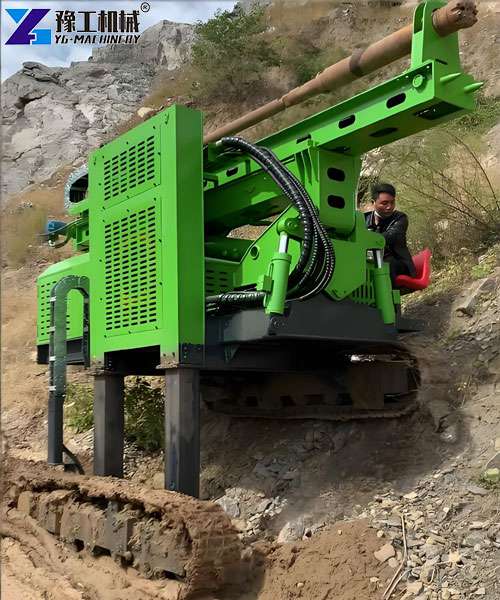
2.Adjustable Outriggers for Uneven Terrain
One of the most important features for slope construction is an adjustable outrigger system.
Modern hillside solar pile drivers can be equipped with hydraulic outriggers capable of adjusting up to 1.2 meters in height.
This allows operators to:
- Level the machine on uneven ground
- Improve stability during pile installation
- Maintain vertical mast alignment
- Enhance construction safety
For projects with varying elevation changes, adjustable outriggers significantly reduce setup time and improve accuracy.
3.Telescopic Sliding System for Precise Positioning
A telescopic sliding solar pile driver offers a major advantage when working on slopes.
The sliding carriage can extend forward to make fine adjustments to drilling and pile driving positions without moving the entire machine.
Benefits include:
- Faster pile positioning
- Reduced machine movement
- Improved installation precision
- Higher productivity on restricted work platforms
This feature is especially useful when pile spacing must meet strict engineering requirements.
4.360° Rotation for Flexible Operation
A 360-degree rotation system allows operators to work in multiple directions without repositioning the crawler chassis.
This capability is particularly valuable on narrow hillside platforms where machine movement is limited.
Advantages include:
- Reduced repositioning time
- Lower fuel consumption
- Increased daily productivity
- Improved accessibility in confined areas
5.Drilling and Pile Driving in One Machine
A multifunctional photovoltaic pile driver for uneven terrain should be capable of both drilling and pile driving.
When hard rock layers are encountered, operators can first create pilot holes before driving the piles.
This eliminates the need for separate drilling equipment and improves overall project efficiency.
International Insights from Hillside Solar Projects
Solar foundation installation challenges vary by region, but many hillside projects share similar requirements.
Papua New Guinea
Many solar projects are located in mountainous areas with soft soil and heavy rainfall.
Equipment stability and terrain adaptability are critical.
Philippines
Developers often face steep slopes combined with volcanic rock formations.
Machines capable of drilling and pile driving offer significant advantages.
Chile
Solar projects frequently encounter rocky terrain and elevation changes.
Accurate pile positioning is essential to reduce installation errors.
Peru
High-altitude solar farms require reliable equipment that can maintain productivity under demanding environmental conditions.
Across all these markets, contractors consistently prioritize:
- Stability
- Precision
- Flexibility
- Productivity
Future Trends in Hillside Solar Construction
As suitable flat land becomes increasingly scarce, more solar projects will be developed on sloped and uneven terrain.
Future solar construction trends are expected to include:
- Larger hillside solar farms
- Increased use of crawler-based equipment
- Greater demand for telescopic sliding systems
- Wider adoption of adjustable outriggers
- More multifunctional drilling and pile driving solutions
Contractors that invest in specialized equipment today will be better positioned to compete in tomorrow’s solar construction market.
Conclusion
Building solar farms on slopes presents unique challenges, including uneven ground, mixed soil conditions, limited workspace, and equipment stability concerns.
To overcome these challenges, contractors should choose a solar pile driver for slope applications that combines:
- Crawler mobility
- Adjustable outriggers up to 1.2m
- Telescopic sliding positioning system
- 360° rotation capability
- Drilling and pile driving functions
A well-designed photovoltaic pile driver for uneven terrain not only improves construction accuracy but also increases productivity and reduces operating costs, making it an essential solution for modern hillside solar projects worldwide.