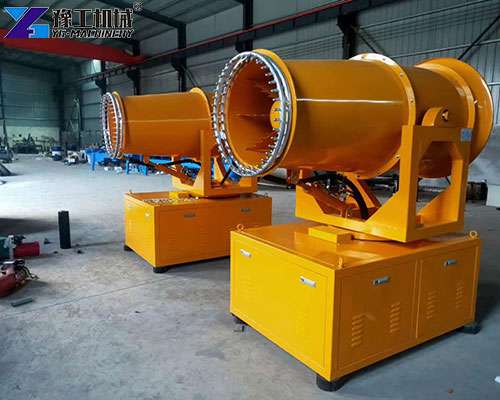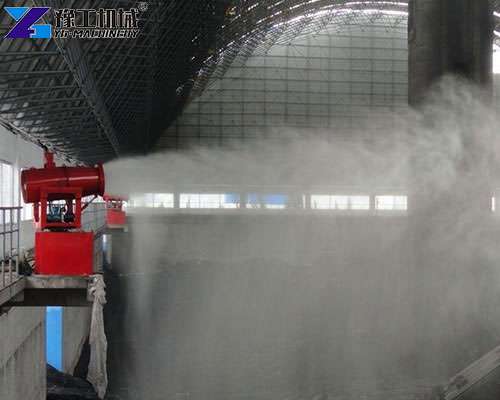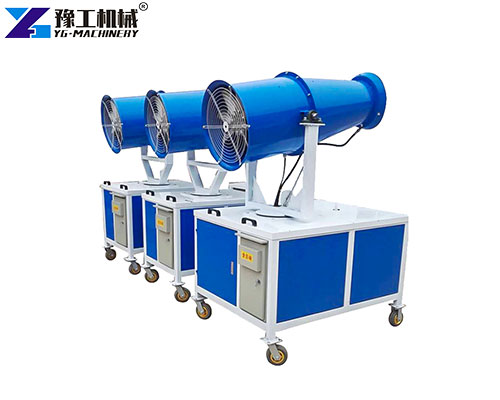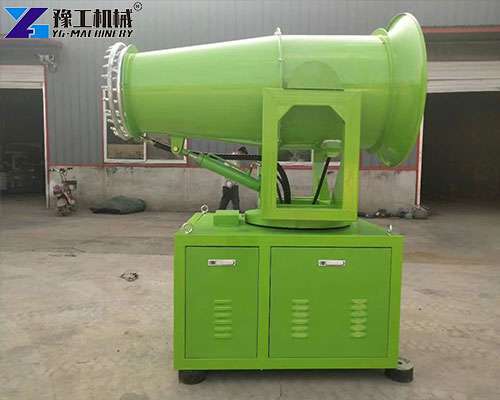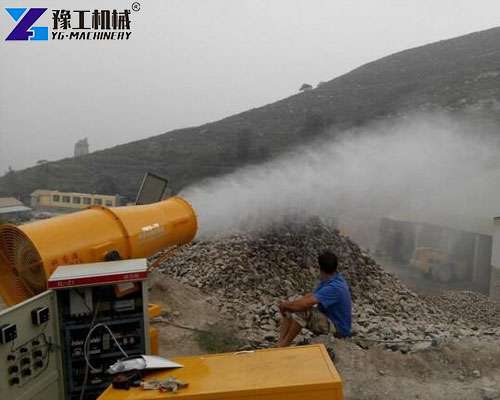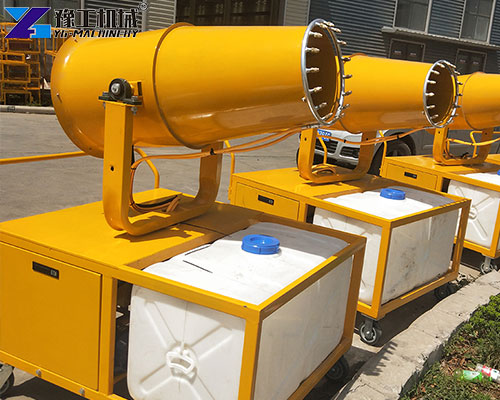
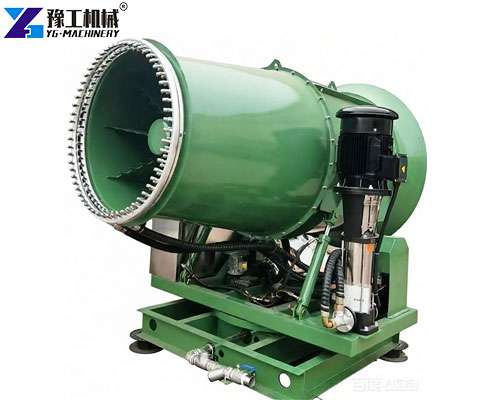
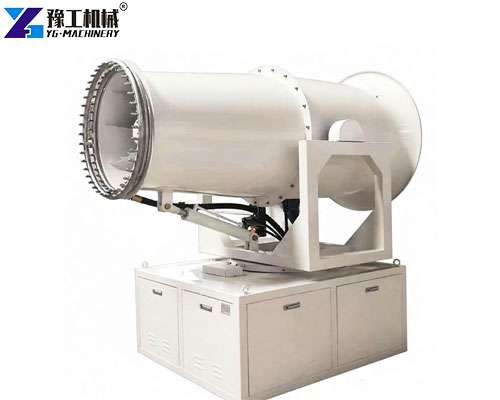
A dust suppression machine plays a critical role in controlling airborne dust during high-intensity construction activities, especially demolition work. In demolition environments, dust is generated suddenly, spreads quickly, and is difficult to manage with manual watering. For contractors and project managers, selecting an appropriate dust control solution directly affects site safety, visibility, and environmental compliance.
Click Here to Get A Free Quote
Dust Suppression Machine Parameters
| Big Model | YG-50 | YG-60 | YG-80 | YG-100 | YG-120 |
| Spray Range | 50 meters | 60 meters | 80 meters | 100 meters | 120 meters |
| Spray Flow | 8 m³/h | 8 m³/h | 12 m³/h | 12 m³/h | 15 m³/h |
| Water Pump Stroke | 140 meters | 140 meters | 160 meters | 180 meters | 185 meters |
| Atomized Particles | 30-150 μm | 30-150 μm | 30-150 μm | 30-150 μm | 30-150 μm |
| Horizontal Rotation Angle | ±160° adjustable | ±320° adjustable | ±320° adjustable | 160° adjustable | 0-320° adjustable |
| Up and Down Pitch Angle | -5° to 35° | -5° to 35° | -5° to 35° | -10° to 45° | 0° to 60° |
| Total Power | 14.5 kW | 24.75 kW | 45.25 kW | 75 kW | 91 kW |
| Power Supply | 380V 50Hz three phase | 380V 50Hz three phase | 380V 50Hz three phase | 380V 50Hz three phase | 380V 50Hz three phase |
| Blower Motor Power | 11 kW | 18.5 kW | 37 kW | 55 kW | 75 kW |
| Water Pump Motor Power | 3 kW (Multistage centrifugal pump) | 5.5 kW (Multistage centrifugal pump) | 7.5 kW (Multistage centrifugal pump) | 11 kW (Multistage centrifugal pump) | 15 kW (Multistage centrifugal pump) |
| Noise Reduction Technology | Sinusoidal noise reduction | Sinusoidal noise reduction | Sinusoidal noise reduction | Sinusoidal noise reduction | Sinusoidal noise reduction |
| Lifting Mechanism | Hydraulic lifting | Hydraulic lifting | Hydraulic lifting | Hydraulic lifting | Hydraulic lifting |
| Left and Right Rotation Structure | High quality reduction motor | Hydraulic rotation | Hydraulic rotation | Hydraulic rotation | Hydraulic rotation |
| Number of Nozzles | 40 | 58 | 80 | 120 | 120 |
| Dimensions | 2000*1500*1500 mm | 1050*1600*2400 mm | 1400*1600*2500 mm | 2700*2000*2300 mm |
Click Here to Get A Free Quote
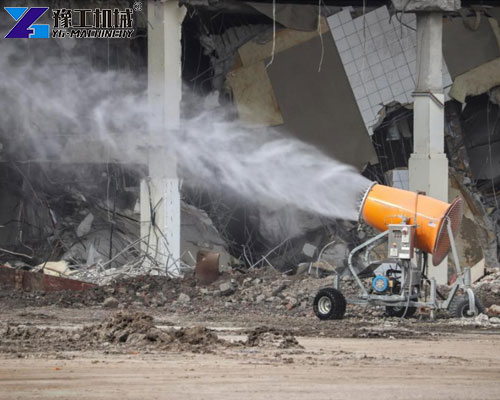
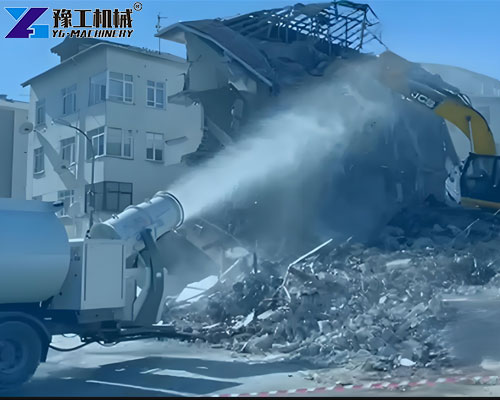
Dust Challenges in Demolition Sites
Demolition sites present unique dust control challenges compared to routine construction work.
Key characteristics include:
- High concentration of fine dust particles
- Irregular dust sources caused by breaking and collapsing structures
- Strong air movement from machinery and open-site conditions
- Limited reaction time once dust is released
Because of these factors, demolition dust suppression requires fast-response equipment capable of covering a wide area within a short time.
Role of Dust Suppression Machines in Demolition Work
In demolition projects, a dust suppression machine is not used continuously but strategically. Its primary function is to suppress airborne dust at the moment it is generated.
Compared with ground-level watering, a dust suppression machine:
- Acts directly on airborne dust rather than settled dust
- Reduces secondary dust caused by vehicle movement
- Improves visibility for machine operators
- Helps limit dust migration beyond the work zone
This makes it suitable for demolition stages such as structural breaking, debris loading, and waste transfer.
Click Here to Get A Free Quote
How a Dust Control Water Cannon Works on Site?
A dust control water cannon uses a high-pressure pump and fan system to project fine mist over demolition areas. The mist binds with dust particles suspended in the air, increasing their weight and causing them to settle quickly.
In demolition scenarios, water cannons are typically:
- Positioned at upwind or elevated locations
- Set to oscillate horizontally to follow dust movement
- Adjusted to moderate mist density to avoid surface flooding
Proper setup ensures effective dust capture without interfering with machinery operation.
Key Considerations for Demolition Dust Suppression
Effective demolition dust suppression depends more on deployment strategy than equipment size.
Important factors include:
- Timing of spraying during active demolition phases
- Matching spray distance to collapse radius
- Avoiding direct spraying against strong wind
- Coordinating with excavators and breakers
These considerations help maximize dust control efficiency while minimizing water consumption.
Click Here to Get A Free Quote
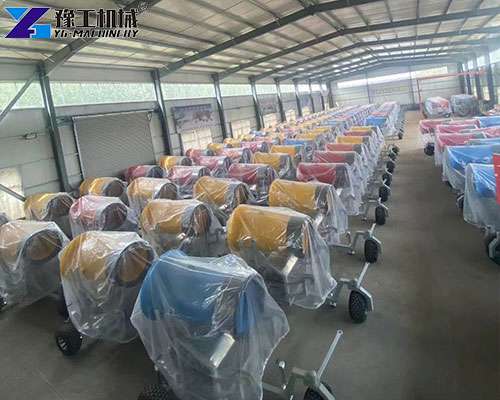
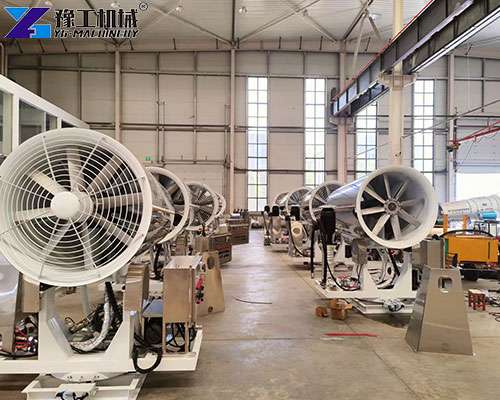
Understanding Fog Cannon Price in Demolition Applications
When evaluating fog cannon price, buyers should consider how the equipment will be used in demolition projects rather than focusing on unit cost alone.
Price is influenced by:
- Required spray distance for demolition scale
- Power source (electric vs diesel for mobile sites)
- Mobility and rotation functions
- Durability under harsh site conditions
In demolition projects, a fog cannon with suitable coverage and fast response often provides better long-term value than lower-cost, short-range alternatives.
Practical Selection Tips for Demolition Projects
For demolition-focused applications, the following selection principles are recommended:
- Choose models with adjustable spray angle and rotation
- Prioritize mobility for frequently changing work zones
- Select power options based on site infrastructure
- Ensure easy maintenance and nozzle cleaning
These factors help ensure the dust suppression machine adapts to dynamic demolition conditions without excessive downtime.
Click Here to Get A Free Quote
demolition dust suppression in YG Machinery
In demolition environments, dust control requires more than basic watering methods. A properly selected and deployed dust suppression machine, supported by a well-configured dust control water cannon, provides an effective solution for managing airborne dust. By focusing on application needs and understanding how fog cannon price relates to real site conditions, project operators can achieve reliable and efficient demolition dust suppression.