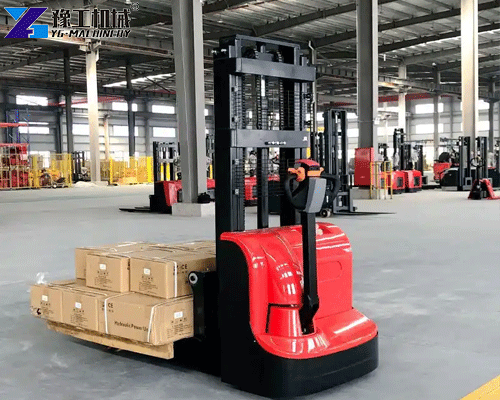
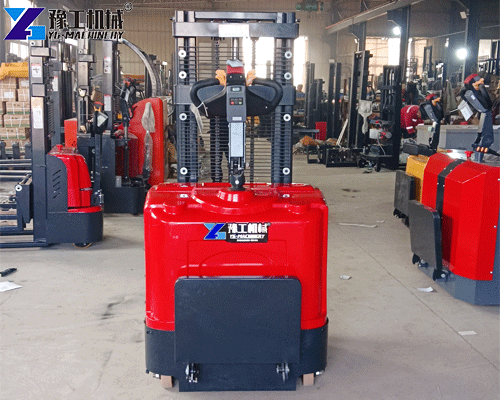
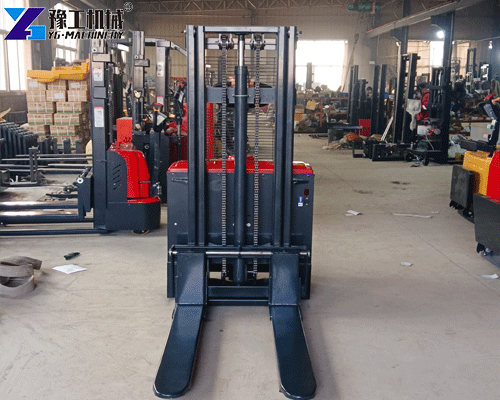
In 2025, an electric stacker truck was selected by a Spanish logistics operator to improve pallet lifting efficiency in a medium-sized warehouse facing labor cost pressure and space limitations.
The project focused on indoor pallet stacking, short-distance transport, and operator safety under European warehouse standards.
Click Here to Get A Free Quote
Project Background: Why Spanish Warehouses Are Replacing Manual Equipment?
Spain’s warehouse and distribution sector has faced rising labor costs and stricter workplace safety regulations since 2024. Many small and medium logistics operators still rely on manual pallet handling or outdated forklifts, which creates three common problems:
- High operator fatigue during repetitive pallet lifting
- Low efficiency in narrow aisles
- Increased risk of minor workplace injuries
The Spanish customer in this case operates a regional distribution warehouse near Valencia, supplying retail goods to supermarkets and local wholesalers. Daily operations involve frequent pallet stacking and retrieval within limited aisle widths.
Click Here to Get A Free Quote
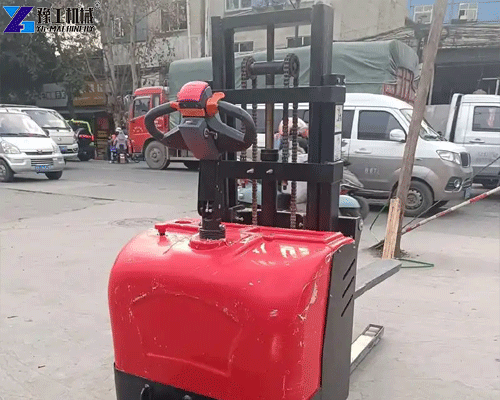
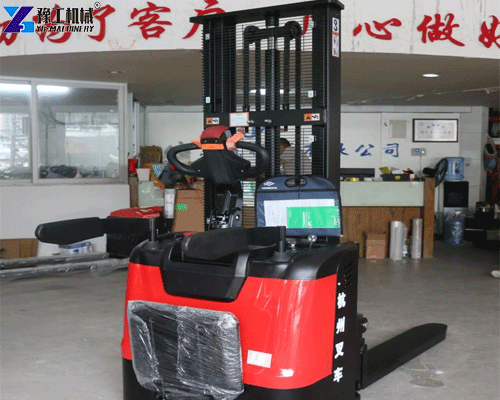
Equipment Overview: Electric Stacker Truck Configuration
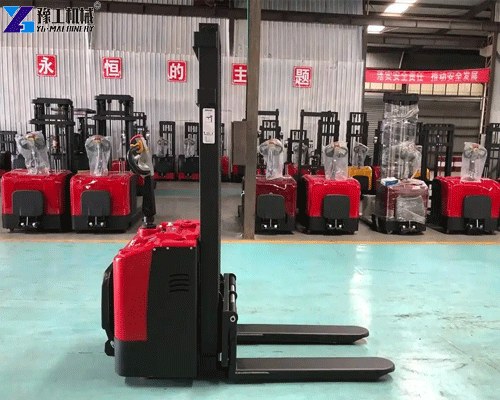
The selected electric stacker truck was configured to meet indoor warehouse requirements rather than outdoor or long-distance transport tasks.
Key Technical Parameters
| Parameter | Stand-on Stacker | Walkie Stacker |
| Power Type | Electric | Electric |
| Driving Type | Stand-on | Walkie |
| Rated Load (kg) | 1000 / 1500 / 2000 | 1000 / 1500 / 2000 |
| Lift Height (mm) | 1600-5000 | 1600-4000 |
| Travel Speed (km/h) | 4.2 / 5.1 | 4.2 / 5.1 |
| Lifting Speed (mm/s) | 70 / 110 | 100 / 135 |
| Max Gradient (%) | 6 | 6 |
| Brake Type | Electromagnetic | Electromagnetic |
| Drive Motor | 1.5 kW | 1200 W |
| Lift Motor | 2.2 kW | 2.2 kW |
| Battery | 48V 32-76Ah | 48V 20-45Ah |
This configuration allowed stable lifting under full load while maintaining compact maneuverability.
Click Here to Get A Free Quote
What Problem Did the Customer Need to Solve?
1.Limited Space and Narrow Aisles
The warehouse layout was designed for pallet racking, not for counterbalance forklifts. Turning radius was limited, and aisle width averaged less than 2.5 meters.
Traditional forklifts could not operate efficiently without frequent repositioning.
2.High Labor Intensity
Manual pallet handling and semi-electric machines required constant pushing and manual lifting assistance. Operators reported fatigue after long shifts, especially during peak distribution hours.
3.Safety and Compliance Concerns
Spanish labor regulations emphasize ergonomic operation and risk reduction. Management wanted to reduce strain-related incidents without redesigning the warehouse layout.
Click Here to Get A Free Quote
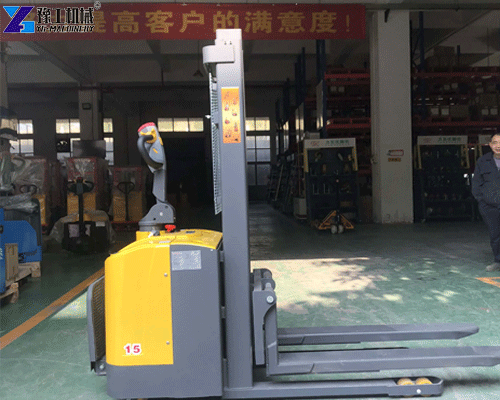
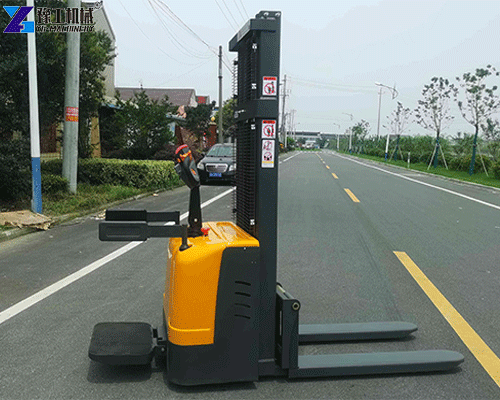
Why an Electric Stacker Truck Was Chosen?
After comparing multiple handling solutions, the customer selected an electric stacker truck based on three technical considerations.
1.Compact Walk-Behind Operation
Walk-behind control provided better visibility and precise positioning. This made it easier to handle pallets close to racking systems.
In customer evaluation, this approach performed better than bulkier alternatives such as an electric straddle stacker in narrow aisles.
2.Full Electric Drive for Indoor Use
Electric travel and lifting eliminated exhaust emissions and reduced operating noise. This allowed uninterrupted operation during working hours without disturbing nearby office areas.
The customer previously tested a stacker pallet jack, but lifting height and stability were insufficient for rack-based storage.
3.Stable Lifting for Daily Operations
Consistent lifting speed under load improved stacking accuracy. Operators reported fewer pallet alignment errors compared with manual equipment.
Click Here to Get A Free Quote
Application Results After Deployment
1.Measurable Efficiency Improvement
After three months of operation:
- Average pallet handling time decreased by approximately 22%
- Operator fatigue complaints were reduced
- Daily throughput increased without adding manpower
2.Improved Safety and Operator Confidence
Walk-behind control reduced blind spots. Emergency stop functions and controlled travel speed improved confidence during peak operations.
The solution proved more suitable than a walkie reach stacker, which required additional operator training and larger turning space.
Click Here to Get A Free Quote
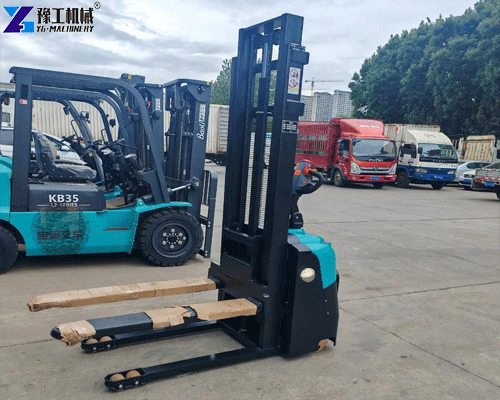
Buyer Decision Logic: Why This Solution Worked?
The purchasing team evaluated cost, training time, and long-term reliability.
1.Cost and Return Consideration
Compared with forklifts, the total investment was lower. Maintenance requirements were simpler, with fewer mechanical components and no fuel system.
2.Training and Adoption
Operators adapted quickly. Training time was limited to basic control and safety procedures, allowing rapid deployment.
3.Availability and Support
The customer selected a walkie stacker for sale option that included spare parts support and standard warranty coverage, which reduced downtime risk.
Click Here to Get A Free Quote
Common Buyer Questions Answered
1.Is It Suitable for All Warehouse Floors?
It performs best on flat, solid indoor surfaces. Uneven outdoor ground is not recommended.
2.What Factors Affect Price?
Price depends on load capacity, lifting height, battery type, and optional safety features.
3.Can It Replace a Forklift?
It replaces forklifts effectively for indoor stacking and short-distance transport but is not designed for long travel or rough terrain.
4.Delivery and After-Sales Support
Standard delivery to Spain was completed within several weeks. After-sales support includes technical guidance and spare parts availability.
Conclusion: A Practical Warehouse Solution for Spain
This Spanish case demonstrates that an electric stacker truck is a practical solution for warehouses seeking higher efficiency, improved safety, and lower operating cost without structural changes.
By matching equipment design to actual working conditions—rather than over-specifying—the customer achieved measurable results with controlled investment.
For buyers evaluating similar warehouse challenges, this case highlights the importance of space efficiency, electric operation, and operational simplicity when selecting pallet handling equipment.